Engineering Payment Systems Banks Can Trust With Every Outcome
Core Decision: Orchestrate With Full Visibility
Core Decision: Orchestrate With Full Visibility
Designing a payment system for a bank means thinking through every path a transaction could take — not just the one where everything goes smoothly. A downstream service responding slowly. A network hiccup mid-transaction. A client resending a request that already succeeded elsewhere. The mark of a genuinely reliable banking platform isn't that these scenarios never occur — it's that the architecture has already accounted for every one of them.
That principle has shaped most of the decisions we've made building payment infrastructure for our banking and fintech clients. I want to walk through one of those architectures in detail — not as an abstract diagram, but as a set of decisions we stand behind, because each one was made with a specific outcome in mind.
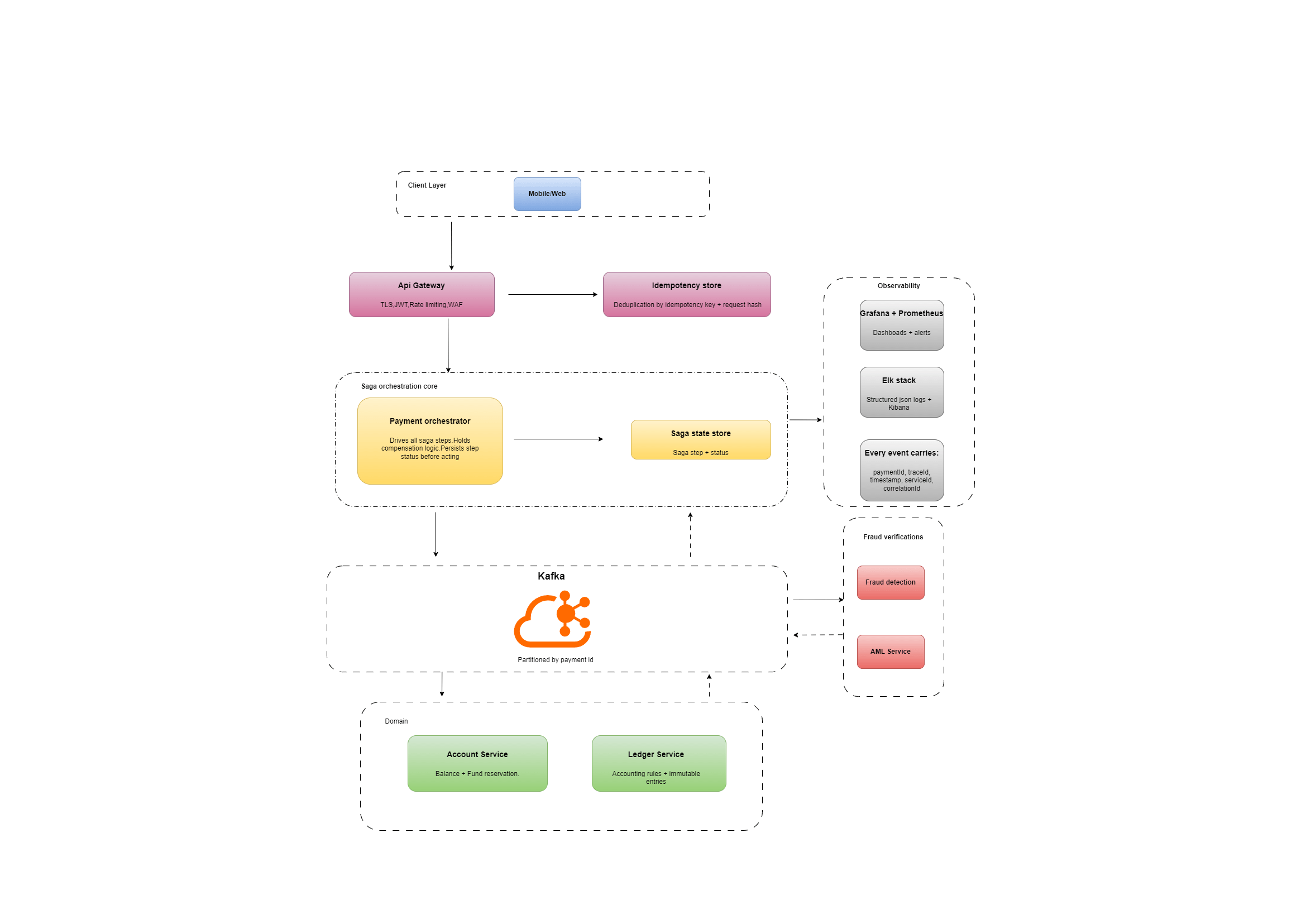
At the center of the system sits a Payment Orchestrator built on the Saga pattern, communicating with domain services exclusively through Kafka. This is a deliberate choice in favor of precision over simplicity: rather than chaining synchronous calls between services, we designed a system that always knows exactly where a payment stands.
The orchestrator drives every payment through a defined sequence of steps. It publishes commands to Kafka, waits for result events from domain services, and advances or compensates based on what comes back. Business logic lives in one place. Services stay independently deployable. And before executing any step, the orchestrator writes its current status to a Saga State Store — which means it's always crash-safe by design: if it restarts mid-payment, it reads its last known state and resumes exactly where it left off, with no ambiguity about what happened.
In a regulated environment, "we can tell you precisely where every payment stands, at every moment" is the standard we build to.
Data consistency in a distributed payment system is the product of several layers working together, each one covering a specific scenario the others weren't designed for.
It starts at the API Gateway, where every request passes through TLS termination, JWT authentication, WAF filtering, and rate limiting. Immediately behind that sits an idempotency store: before a payment reaches the orchestrator, we check whether the same idempotency key and request hash have already been seen. If they have, we return the cached response instead of processing a duplicate — so a client resending a request after a network delay is handled correctly by design, not by chance.
From there, consistency compounds:
Each domain service checks a processed-events record before acting on a Kafka message and marks it done in the same transaction as the business logic itself. That single pattern turns Kafka's at-least-once delivery guarantee into effectively-exactly-once processing at the application layer.
The Account Service applies row-level optimistic locking on balance writes, so two concurrent modifications are resolved cleanly rather than one silently overwriting the other.
The write model is strongly consistent; read projections used for dashboards and lookups are eventually consistent with millisecond lag. That's the right tradeoff for a screen, and our architecture keeps that path clearly separate from anything touching a balance decision.
None of these are exotic techniques. What matters is that they're applied together, deliberately, at the specific points where each one adds the most value — engineered in from the start, not layered on after the fact.
For a banking client, being able to show exactly what happened to a payment, and when, is a core requirement — one that shows up in AML investigations, dispute resolution, and central bank reporting. We treat it as a first-class architectural constraint from the outset.
Every event in the system carries a standard envelope — event ID, event type, payment ID, correlation ID, causation ID, trace ID, timestamp, service ID. Kafka's durable log does double duty here: it's both the message bus and a secondary audit trail. Because of that, the full lifecycle of any single payment can be reconstructed at any past point in time by replaying events from the store — no fragile database snapshots, no piecing together a timeline from scattered logs. Observability tooling on top — Grafana and Prometheus for SLA dashboards and saga-step timings, ELK for full-text search across structured logs — means any payment can be traced end-to-end from a single ID, whenever an engineer or an auditor needs it.
This is what it means to build a system that produces its own evidence. In a regulated environment, that's what makes a compliance review straightforward rather than stressful.
One pattern I'd highlight for other technical leaders evaluating payment architectures: real-time processing and synchronous processing aren't the same thing, and treating them as interchangeable is where a lot of unnecessary complexity gets introduced.
Our system uses a two-phase response model. The client gets an immediate acknowledgement; the final result arrives asynchronously, via webhook or push notification, once the saga completes. That keeps the synchronous path deliberately short — gateway, idempotency check, orchestrator write, response. Kafka's sub-millisecond propagation keeps inter-service latency negligible, and non-critical steps run fully async, never adding weight to the payment path. The result feels instant to the end user, by design.
Fraud detection and AML screening run as independent Kafka consumers, which means they scale, deploy, and evolve on their own schedule — without ever adding latency to the payment flow. Every decision they make is recorded as an event carrying its full reasoning payload, so the compliance record is the actual decision trail, captured as it happened, not a summary written after the fact.
I'm sharing the mechanics of this architecture because I think the details are the point. It's easy for any vendor to claim they build "banking-grade" systems. It takes real engineering depth to show the specific design decisions — precision-tracked orchestration, layered consistency guarantees, built-in auditability, independently scaling fraud screening — that turn that claim into a guarantee.
This is the standard we hold our own engineering teams to, and the standard we'd encourage any bank or fintech to hold their delivery partners to. Building a payment system that performs well in a demo is one thing. Building one engineered for every outcome, from day one, is what we consider the actual job.
Robert Tamas is CEO of OceanoBe Technology, a Romania-based software development company building banking, fintech, and payments infrastructure for European and international banks and payment networks. He works closely with clients to provide solution-fit teams of experienced engineers, while his technical background guides his decisions behind the company's core delivery work.